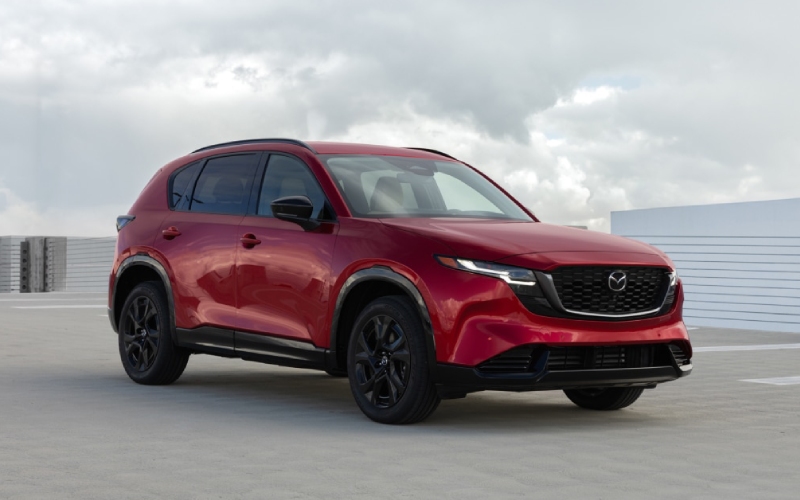
Cardinale Mazda - Which SUV Handles Coastal Grades Better — 2026 Mazda CX-5 or 2026 Honda CR-V near Pebble Beach, CA?
Context drivers care about
Coastal routes near Pebble Beach, CA blend postcard views with real-world driving challenges: undulating grades, sudden crosswinds, and frequent merges around sightseers or weekend traffic. When shoppers ask which SUV handles those grades better—the 2026 Mazda CX-5 or the 2026 Honda CR-V—we break it down to traction strategy, transmission behavior, chassis tuning, and in-cabin tech that supports calm, clear decisions. Both nameplates are capable, but their approaches differ in ways you’ll feel immediately on CA-1 and the rolling links to 17-Mile Drive.
Mazda equips every CX-5 trim with i-Activ AWD from the start. That matters on coastal pavement because traction isn’t just for rain or loose surfaces—it’s also for those quick transfers of weight when you crest a rise, turn over cracked asphalt, or merge onto a short on-ramp with a tailwind shoving you along. The system continuously monitors wheel slip and driver inputs, sending torque where you need it without a drama spike. Honda’s Real Time AWD™ is available on most CR-V trims and standard on select ones, and it’s well-tuned, especially when paired with the hybrid’s responsive torque. Still, the CX-5’s across-the-board AWD coverage simplifies the decision and means your traction toolkit is always on hand, regardless of the trim path you choose.
How transmissions shape confidence on grades
The 2026 CX-5 uses a conventional 6-speed automatic that many drivers prefer on hills. With distinct, predictable gear steps, it gives you a direct feel on descent and steadier response on ascent; it’s easy to anticipate how the SUV will react to a little more throttle as you pass a slow-moving truck. The CR-V’s continuously variable transmission (CVT) is refined and efficient, and Honda’s hybrid trims add an immediate torque feel that’s reassuring at low speeds. Yet if your confidence is tied to that familiar shift cadence and engine braking feel, the CX-5’s setup often feels more natural, especially on rolling, imperfect pavement where split-second adjustments reduce stress.
Chassis tuning you can feel
Mazda’s chassis philosophy centers on subtle body control and crisp steering feedback. G-Vectoring Control Plus proactively nudges torque to help the CX-5 set into a turn and straighten smoothly, which sounds esoteric until you realize it means fewer steering corrections when wind gusts slap across a bridge or when a corner tightens unexpectedly. Honda aims for a comfortable, secure ride profile as well, and higher trims are impressively composed for daily use. The difference is texture: the CX-5 communicates just enough through the wheel to build trust without delivering harshness, which keeps shoulders loose and reactions quick mile after mile.
That balance matters when you stack real-world variables: a bluff-side crosswind, a damp patch in the shade, and a queue of tourists braking for a turnout. With standard AWD and that conventional, well-matched transmission, the CX-5 tends to feel planted and predictable, so you can thread through situations with minimal fuss. The CR-V will get you there, but many drivers report the Mazda encourages a steadier rhythm on grades and switchbacks.
Tech that reduces second-guessing
The newest CX-5’s available 15.6-inch touchscreen with Google built-in brings a clear, uncluttered interface to mapping, media, and voice assistance. The size helps—route previews and lane guidance are easier to read at a glance—and the integration keeps directions fresh. Honda also offers Google built-in on specific CR-V trims, and its standard 9-inch screen is straightforward to use. If top-tier clarity is a priority, the CX-5’s larger, integrated display and calm UI can make a difference when traffic suddenly compresses, and you’re scanning for the correct exit or turn-in.
- AWD availability: CX-5 includes standard i-Activ AWD on every trim; CR-V offers Real Time AWD™ on many trims and makes it standard on select ones.
- Transmission feel: CX-5’s conventional 6-speed automatic delivers predictable shifts and engine-braking confidence; CR-V’s CVT emphasizes smoothness and efficiency.
- Chassis character: CX-5 favors calm precision with G-Vectoring Control Plus; CR-V targets comfort and stability, with an edge toward efficiency in hybrid trims.
- Navigation clarity: CX-5’s available 15.6-inch display with Google built-in enhances glanceability; CR-V’s 9-inch screen and available Google built-in are clear and user-friendly.
Beyond the spec sheet, confidence on coastal grades is a feeling—how immediately the SUV settles after a lane change, how predictably it responds to an extra toe of throttle, and how little you need to think about traction mid-corner. In our test drives, the CX-5’s standard AWD and conventional automatic consistently give drivers that “I know what the car will do next” assurance. The CR-V’s hybrid system adds a nice punch from a stop, and its tuning is commendably smooth; shoppers focused on that electric-aided feel may gravitate to upper CR-V trims. For the majority who want the same confident template on every CX-5 trim, Mazda’s approach is refreshingly straightforward.
Who should choose which?
Choose the CX-5 if your routes mix coastal grades, inland heat, and busy connectors where traction and predictable shifts matter. Choose the CR-V if you’re set on the hybrid’s personality and prefer its tech and interior packaging in top trims. Either way, a careful drive on your usual roads—merges, rises, and lane changes included—will tell you more than any spreadsheet. Bring your questions and your must-drive roads list; we’ll map out a loop that highlights what you care about most.
For personalized help aligning features to your drive, Cardinale Mazda is here to guide the process—serving Monterey, Pebble Beach, and Carmel-by-the-Sea with product specialists who understand local routes and real-world needs.
Frequently Asked Questions:
Is AWD standard on every 2026 Mazda CX-5 trim?
Yes. i-Activ AWD is included across the CX-5 lineup, so you don’t have to step up to a specific trim to get it.
Does the 2026 Honda CR-V offer AWD on all trims?
AWD is available on most CR-V trims and standard on select upper trims, but it isn’t standard across the entire lineup.
Which feels more predictable on downhill grades?
Many drivers prefer the CX-5’s conventional 6-speed automatic for its familiar shift points and engine-braking feel, especially on rolling descents.
Do both SUVs offer Google built-in?
Yes, but availability varies by model and trim. The CX-5 offers Google built-in on an available 15.6-inch touchscreen, while the CR-V includes Google built-in on specific trims.
How can I test these differences locally?
Schedule back-to-back drives on your everyday routes, including your usual coastal connectors and freeway merges. You’ll sense traction and transmission behavior within a few miles.